

Which areas stand out in Türkiye's climate transformation towards COP31?
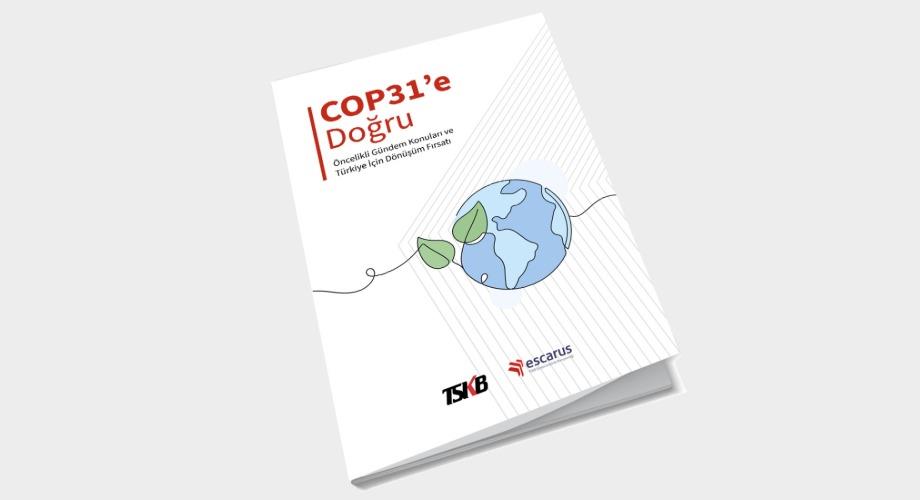
Prepared by Turkish Industrial Development Bank (TSKB) in cooperation with Escarus.“Towards COP31: Priority Agenda Issues and Transformation Opportunity for Türkiye” published its report. The report evaluates the change in the global climate agenda as COP31 preparations continue and the prominent transformation areas for Türkiye.
Climate finance, energy transformation, decarbonization in industry, adaptation to climate change and just transition are among the prominent topics in the study.
Focus on climate agenda shifts to implementation
The report treats the period that started after the first Global Stocktaking within the scope of the Paris Agreement as a process that focuses on the implementation of existing targets rather than the determination of new targets.
In this context, zero waste, clean energy transformation, green industrialization and climate resilient cities are among the priority application areas.
Developed under the leadership of TürkiyeClimate Application Bridge is one of the mechanisms highlighted in the report. The initiative aims to support the implementation of countries' National Contribution Declarations, transform national priorities into investable projects and facilitate access to climate finance.
Energy transition combines with economic security
The TSKB report points out that energy transformation is no longer considered only within the scope of climate policies. Energy security, economic security and industrial policies are also becoming important parts of the transformation.
With geopolitical developments, the debate on energy supply security goes beyond oil and natural gas. Access to electricity infrastructure, critical minerals and clean energy technologies also gains importance in this context.
According to the report, electrification needs to be expanded, especially in the industrial and transportation sectors. Planning this together with energy production and network investments is important for the sustainability of the transformation.
Investable projects are important in climate finance
Financing low-carbon transformation is one of the main topics of the report.
Strengthening Türkiye's capacity to access climate finance and developing project portfolios that will support low-carbon investments in industry are among the priority areas.
Reducing capital costs in developing countries, expanding risk-sharing instruments such as guarantees and insurance, and taking on a more active role of multilateral financial institutions are among the tools that can facilitate access to finance.
The report also highlights that it is increasingly important for financial institutions to incorporate physical climate risks into their credit, investment and risk management processes.
Water management comes to the fore in adaptation investments
On the side of adaptation to climate change, water security is among the issues that attract attention.
According to the report, it is necessary to expand climate-resilient infrastructure, use digital technologies in water management and increase investments in alternative water resources.
For the growth of adaptation finance, it is also important for the public and private sectors to act together and to develop financial mechanisms that support private sector investments.
The social dimension of transformation: Just transition
The transition to a low-carbon economy does not affect every sector and region in the same way. Therefore, the report considers a just transition as one of the fundamental elements of climate transformation.
Policy and support mechanisms that take into account the different needs of sectors and regions are needed to prevent new social and economic inequalities that may arise during the transformation process.
This approach shows that climate policies should be addressed not only with emission reduction targets but also with the economic and social consequences of the transformation.
Implementation capacity will be decisive as we go to COP31
TSKB and Escarus' evaluation shows that the main question on the climate agenda towards COP31 is increasingly shifting from "which targets to set" to "how to implement these targets".
For Türkiye, accelerating energy and network investments, low-carbon transformation of industry, access to climate finance, water security and climate resilient infrastructure are the prominent areas in this process.
The determining factor in the process leading to COP31 will be the extent to which the targets can be transformed into financed, feasible and measurable projects.
Source:TSKB and Escarus,Towards COP31: Priority Agenda Issues and Transformation Opportunity for Türkiye, 2026.