


The world produces enough food. So why not expect 2,69 billion people healthy?
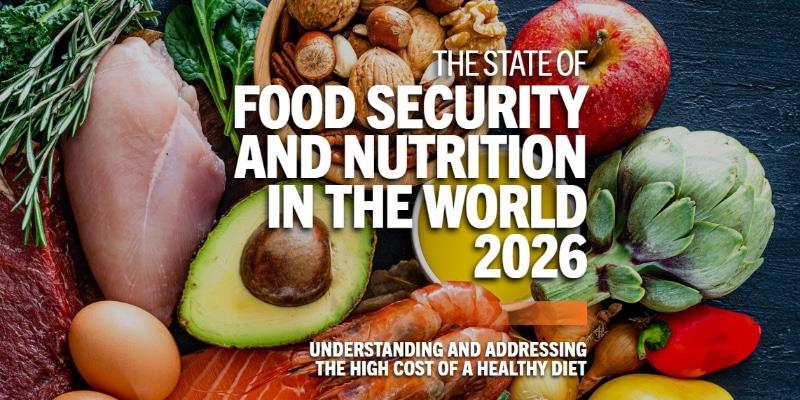
The two facts that hopes and thought about the 2026 Food Safety and Nutrition Status (SOFI) report of the United Nations appear at the same time. While global hunger is back to the third year, about 2,69 billion people in the world cannot afford a healthy diet scheme. This table shows that the problem can not only be explained by food production.
In recent years, the pandemi, battles, economic fluctuations and climate crisis were limited to the fight against hunger. According to SOFI 2026 report, 7,8 percent of the global population in 2025, namely about 645 million people faced hunger. This number is about 14 million per previous year, compared to 2022, 43 million lower.
However, this is not the message that the report attracts attention.
Because of the same year, 25,8 percent of the world population, about 2,1 billion people, medium or serious levels of food have experienced insecure. Even more striking, 2,69 billion people could not afford the cost of a healthy diet scheme. [[T]]]
This situation reveals an important fact: It can be reduced hunger, but access to healthy food is still not economically possible for billions of people. [
[
Not only production that makes food expensive
Most of the time when talking about food prices, production costs stand out. Yet SOFI 2026 report shows that the large part of the consumer pays is not in the field, but in the following processes from harvest.
According to the report, 75 percent of the price paid by the consumer is caused by value chain activities such as processing, storage, transportation and distribution of food. Approximately 40 percent of the total cost consists of processing, logistics and wholesale distribution stages.
This table shows that food systems are not only agricultural production. The infrastructure, logistics networks and cold chain systems connecting table with the field are among the elements that directly affect the price of healthy food.
[
Energy costs extend to table]
]
Cold storages, processing facilities, packaging centers and shipping networks are required to reach the consumer without distortion of products. All these processes are using intensive energy.
Increase in electrical prices, energy dependence in fuel costs and fertilizer production, affect every ring of food chain. Therefore, fluctuations in energy markets are not only industrial production, but also important factors that determine prices on market shelves.
SOFI 2026 report is not only looking for more production. The United Nations emphasizes that food value chains should be brought more efficient, the development of cold chain infrastructure, increasing irrigation investments and strengthening logistic systems. The aim is to reduce both food losses and to ensure the feeder foods reach the consumer at lower cost.
]
The system can grow both hunger and obesity]
]
Another finding that draws attention to the report is the contradiction in the global feeding table.
150 million children all over the world are still struggling with stagnation. Children can feed only 30,8 percent in the critical period of their lives.
On the other hand, adult obesity continues to increase. In 2012, 12,1 percent of adult population across the world, while this rate rises to 16,2 percent in 2024.
At first glance, these two tables may appear opposite to each other. But in fact, it reflects different faces of the same problem.
Nutritionists have long been aware that getting enough calories does not mean healthy nutrition. Rich in energy but access to low foods is often easier and cheaper, fresh vegetables, fruits, dairy products and quality protein sources are becoming economically available for many households.
Therefore, today’s global nutrition problem is not only hunger; it is also considered as inequalities in access to healthy nutrition.
] The regional inequalities are deepened]
SOFI 2026 report reveals that global averages hide significant differences. [
Latin America and the Caribbean with Asia continue to be the most fragile region in the African world while successing hunger rates in recent years.
Around 309 million people in Africa in 2025 struggled with hunger. 66,6 percent of the continent population also has no economic opportunity to meet a healthy diet scheme.
In response to North America and Europe, the ratio of those who live in moderate or severe levels of food in 8,7 percent.
This difference is not only sourced from the income level. When evaluated with agricultural efficiency, infrastructure investments, transportation systems, trade policies and climate conditions, the cliff between regions is more pronounced.
The attack and conflicts risk gains
The report also emphasizes that there is no guarantee that the progress recorded in the last three years is permanent.
Increased energy and fertilizer prices of conflicts in the Middle East in 2026, creating new prints on food inflation. When it is added to extreme weather events and the potential effects of El Niño on agricultural production, the global food system is still fragile against new shocks.
Even if the trend available according to the projections of the United Nations continues, 510 to 520 million people are still expected to face hunger. This also shows that it is quite difficult to reach the zero hunger target set within the Sustainable Development Objectives.
[
The future of food system is not only shaped in the field]
One of the most important messages of SOFI 2026 is that food safety can now be explained only with the amount of production.
Producing more food in one country is not enough alone. It is decisive that food can be stored securely, transported with low loss, operating at affordable cost and access to the consumer. [
Therefore, the future of food systems requires a holistic transformation from energy infrastructure to logistics networks, from cold chain investments to sustainable agricultural applications.
The world produces food as much as it can do everyone today. The main question is no longer what we produce, it can be accessed for everyone, we won’t return the nutrients and economics.
[
[ Source:][
FAO, IFAD, UNICEF, WFP and WHO (2026).
The State of Food Security and Nutrition in the World 2026 (SOFI 2026).
Source: Sustainable Living