


A more blue world...
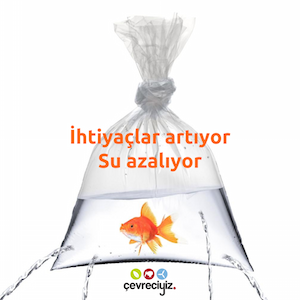
From 22 March of the United Nations announced the World Water Day. In recent years, the theme set for this year of the UN, highlighting the relationship of water with concepts such as energy, food safety, urbanization, health, drought, “]]Water and Sustainable Development”. We decided to browse some figures about how our current preferences affect the water and how the water shaped our future...
[[T]]] [
]]
Although the calculation method looks complicated, WWF]]- When the coffee sample of Turkey is read, it is understood that a cup of coffee is needed much more than a glass of water. The journey of coffee consists of the following steps:
The growing of coffee plant
The amount of water required to come to our coffee table is 140 liters. (If you want to drink your coffee in the paper cup, milk and sugar according to the figures shared by the WWF-Turkey, this amount comes to 208 liters.]
[
[
]
[
]
]
[
[
[Note: For information on the Water Footprint used in the article, the WWF-Turkey and the Forest and the Ministry of Water Works prepared in cooperation with The Water Footprint Report of Turkey], ]]Water Footprint Network[133]]] and [The united Nations data have been used.
[[T]]] [
Previously water sources: [
- 97% of the earth covered with water, but 97% of this water consist of salty sea and ocean waters. [
- In this case, we see only 3% of the water on the world is sweet water, but almost three of them are in the form of mountain frosts and polar buzu.
- In summary, our share from the water on the earth falls only 1%.
]
What is the case of the demand for water?]
- Global water consumption increased 3 times in the last 50 years.
- The economy is growing, the population is growing rapidly... For this reason, 50% of global water consumption in developing economies in the next 10 years is estimated to increase by 18% if in developed economies.
- It is necessary to think not only houses when water consumption, agriculture and industry. Approximately 400 percent of the demand for water used in production between 2000-2050 is expected.
- We may ask you to remember the water interruptions experienced in the summer, but there is a fact that we will not ignore: about 750 million people across the world deprive of clean water sources.
- Grant threatens the life of 1,4 billion people living in 110 countries. [
- Let’s consider the danger as far as we’re talking about the continuous world. Because Turkey does not accept water rich as a country. Due to its increased population, rapid urbanization and growing industry, the need for water consumption of our country is expected to increase 3 times in the next 25 years.
It is necessary to think well about water because it increases quickly to a limited source. It is important to repair drip taps, to apply savings methods at home such as using efficient fixtures, of course, but to think a little too big. Because there is water in almost everything we use. By doing the right preferences, we can save water not only in the water we consume in homes and offices, but also save our water footprint in the products we use.
First time revealed in 2002 Water Footprint The concept expresses much more than the water consumed directly. The water we use for our needs such as food, drinking, cleaning, personal care, is the only visible face of ice mountain. When the products we use are produced, the amount of water is consumed. Our footprint in the water also comes into account all these criteria.
Although the calculation method looks complicated, WWF]]- When the coffee sample of Turkey is read, it is understood that a cup of coffee is needed much more than a glass of water. The journey of coffee consists of the following steps:
The growing of coffee plant
By doing,
Explosion,
,
]
Bundle of coffee beans,
Sale of coffee
Filling the coffee into the cup.
The amount of water required to come to our coffee table is 140 liters. (If you want to drink your coffee in the paper cup, milk and sugar according to the figures shared by the WWF-Turkey, this amount comes to 208 liters.
[
You need to review about 30 liters of water if you use your tea. One simple pizza 1260 litres means 1700 litres of water if a kg of beef 16 thousand liters, 100 grams of chocolate. Of course, work is not limited to food only. Everything from the shirt we dress up to the energy we consume to warm up from the paper we write on.
The creator of my husband ]Profesor Arjen Y. Home states that topics such as water shortage and pollution can be understood as a whole of the production and supply chain. According to Hoekstra, “]is closely connected with the structure of global economy in general. Many countries import water footprints, more than water density from other regions, greatly excludes products and goods. This creates a print on water sources in export countries where experienced water management mechanisms are largely missing. " In summary, if a country is rich in water resources, it is necessary to necessarily save in water consumption.
]
From the biggest production powers of the world, the water ayaz trail of China is about 700 m3 per year. The biggest consumer in the world is in the US, this figure is 2500 m3. Our country’s annual water footprint approached 2000 m3. 80% of production and consumption in Turkey are based on internal water resources, the sustainability of water resources directly affects the country economy.
What should we do to minimize our individual and socially water footprint? First we need to adopt applications that help save water in our homes and offices. Let’s forget that these types of daily habit changes to support the sustainability of the water will also relieve our bills in the short run.
]
We can then focus on our water footprint and our influence on nature, thinking a bit larger diameter. By choosing conscious products we use, it is possible to reduce our footprint in water by turning our waste back, not only water, but also energy saving; by establishing a sustainable life with summary.
In Turkey, 11 percent of the water is used in the industry, 15 percent in homes and 74 percent in agriculture. Therefore, it is necessary to pay special attention to the efficiency projects in production and agriculture. [
]
The reason why the lion share in the water consumption does not take agricultural production, wild irrigation methods. 75 percent of the water used in agriculture is consumed in the form of salma irrigation, 17 percent of raining and 8 percent drip irrigation. The use of methods such as drip irrigation in agricultural production leads to healing not only in many different areas. With drip irrigation, it can water up to three floors using the same amount of water with salma irrigation. Thus, the agricultural fields that are left from thirst are brought into production, the efficiency is increasing. Intelligent use of water in agriculture prevents salting and erosion of the territory.
If the water is used efficiently, it triggers saving in many sectors associated with each other. Water is one of the most important inputs in production. 10 liters of water is consumed to produce a page paper. Full 91 litres if the footprint of 500 grams of plastic in water. No product we use in daily life, no water is used in production. For all these reasons, it is necessary to pay attention to the sustainable use of water in production.
The presence of water, which is indispensable for consumption and more importantly living, is an integral requirement of sustainable development. We must organize all our preferences according to the efficient use of water to look at the future. The amount of water in the earth will not increase, but using the existing water correctly, we can increase the number of years that we will pass in peace with water, let the next generations a blue world.
Whether your World Water Day is celebrated.
Source: Sustainable Development