


Report
2026 Planetary Health Report: Seven of nine planetary boundaries exceeded
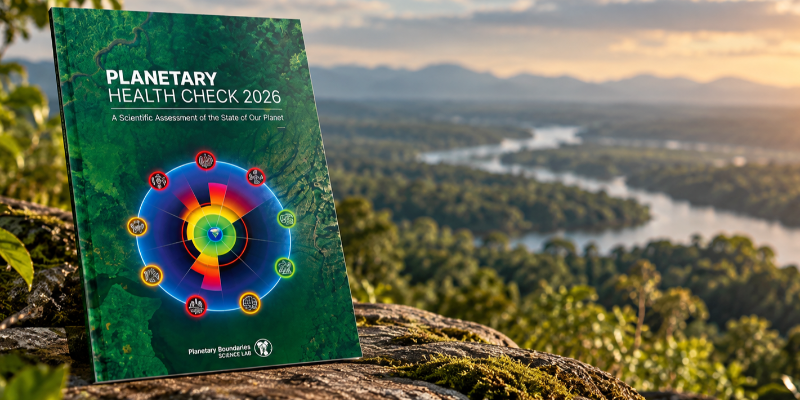
If the ozone layer is recovering, can we save other systems as well? From the Potsdam report.
The pressure on Earth's essential life-supporting systems, from climate to freshwater, oceans to ecosystems, is increasing. Seven of the nine planetary boundaries are now outside the safe operating zone, according to the 2026 Planetary Health Check report published by the Potsdam Institute for Climate Impact Research. Moreover, pressure continues to increase on all seven borders.
The report, prepared with the contribution of more than 60 scientists, evaluates planetary boundaries not as independent environmental problems, but as processes that together determine the stability and resilience of the Earth system.
What do planetary boundaries indicate?
The planetary boundaries approach was first developed by scientists in 2009. The framework seeks to understand within what limits human activities must remain so that the Earth system can maintain its stability and capacity to support life.
Exceeding these limits does not mean that the system will suddenly collapse at a certain point. Instead, it indicates an increased risk of large-scale, permanent and potentially irreversible changes occurring.
According to the 2026 assessment, seven boundaries that fall outside the safe working area are:
1. Climate change
2. Change in biosphere integrity
3. Land system change
4. Fresh water change
5. Change in biogeochemical fluxes
6. Introduction of new entities into the environment
7. Ocean acidification
According to the report, all seven limits are at the highest exceedance level ever recorded.
The seventh frontier is ocean acidification
The latest critical change to be added to the table of planetary boundaries has occurred in the oceans. Ocean acidification exceeded the safe limit in 2025, becoming the seventh planet to enter the risk zone.
Oceans absorb a significant portion of carbon dioxide from human activities. This process changes the chemistry of seawater while limiting some of the increase in carbon dioxide in the atmosphere. Increasing acidification puts pressure on corals and shell-forming marine organisms in particular.
Therefore, climate change and ocean acidification are not two independent problems. One of the main reasons for both is carbon dioxide emissions from fossil fuel use.
The planet's natural buffers are weakening
One of the issues that the 2026 report particularly focuses on is the future of carbon sinks.
Vegetation and soils act as a natural buffer in the climate system by absorbing a significant portion of the carbon dioxide released into the atmosphere as a result of human activities. However, repeated temperatures, drought, fires and ecosystem degradation can reduce this capacity.
The report points out that the carbon sequestration capacity of terrestrial ecosystems may be assumed to be more resilient than in models. This issue is particularly important for net zero targets, because some future emissions scenarios are based on the assumption that natural carbon sinks will continue to operate.
If the carbon sequestration capacity of natural systems weakens, not only ecosystems but also the calculations made to achieve climate targets may be affected.
Two borders in safe work area
The whole picture does not move in the same direction. Stratospheric ozone depletion and atmospheric aerosol load remain within the safe operating range on a global scale and have been improving over the past decade.
The recovery in the ozone layer is one of the strongest examples of how international environmental policies can produce results. The Montreal Protocol, which limits the use of substances that damage the ozone layer, showed that environmental pressure can be reduced when joint action is taken on a global scale.
Atmospheric aerosols are also improving on a global scale. But the report warns that the global average may mask persistently high aerosol levels in some regions. Therefore, global recovery does not mean that the problem has been solved in every region.
Not seven separate crises, but an interconnected system
One of the most important points of the planetary boundaries approach is that it does not evaluate environmental problems independently of each other.
Climate change can affect the water cycle. Changes in land use can reduce both biodiversity and carbon storage capacity. Disruption of nitrogen and phosphorus cycles can affect freshwater and coastal ecosystems. Increasing carbon dioxide emissions simultaneously warm the atmosphere and change the chemistry of the oceans.
Because of these connections, disruption at one boundary can also increase pressure on other systems.
The main message of the report is therefore not just “seven out of nine limits have been crossed”. The point is that pressure is increasing simultaneously in different parts of the Earth system.
The margin of error is narrowing
Boris Sakschewski, one of the lead authors of the report, emphasizes that pressure on all borders outside the safe working area is increasing, increasing the risk of large-scale, permanent and potentially irreversible change.
This table also shows that the area of intervention has narrowed. The longer the stress on an environmental system continues, the more difficult it may become to return it to a safe operating area.
However, the report does not say that return is impossible.
PIK Director and co-author of the report, Johan Rockström, points out that humanity has the knowledge, capacity and solutions necessary to change direction. The development of the ozone layer also provides a concrete example that environmental pressures can be reduced with the right science, policy and international cooperation.
We can't measure planetary health with a single indicator
While climate change is at the center of the environmental agenda, the 2026 Planetary Health Check reveals a broader picture. The stability of the Earth does not depend only on the increase in temperature in the atmosphere; The chemistry of the oceans, the freshwater cycle, the integrity of ecosystems, land use and new chemicals released into the environment are also parts of the same system.
The fact that seven out of nine borders have been breached indicates that these systems are increasingly under pressure. On the other hand, the improvement in the ozone layer also reminds us that the direction can be changed.
The fundamental question posed by the planetary boundaries approach is therefore not just how much damage we do, but how we can move the Earth system back into a safe operating environment.
Source:
Potsdam Institute for Climate Impact Research, Planetary Health Check 2026: A Scientific Assessment of the State of the Planet, 2026.